 100% Free Cancellation
 Tripadvisor Travelers’ Choice 2025

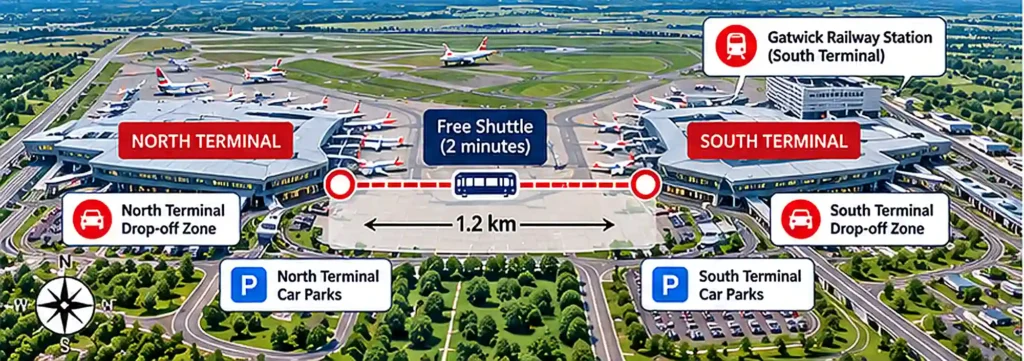
Gatwick Airport has two passenger terminals: North and South. They are around 1.2 km apart and connected by a free automated shuttle. Check which terminal your airline uses before you set off; arriving at the wrong one can add an avoidable detour, especially if you are travelling with luggage or on a tight schedule.
This guide includes a Gatwick Airport map and explains where to find each terminal, how to travel between them, and what to know about drop-off, airport facilities and onward journeys.
I’m Yasir Saeed, Social Media Manager and Content Strategist at Elite Airport Transfer UK. We regularly speak with passengers travelling to Gatwick, and the same questions come up: Which terminal do I need? How do I get between them? Where can I be dropped off? What will it cost? This guide answers them all.
- Two terminals: North (RH6 0PJ) and South (RH6 0NP).
- The free shuttle runs 24 hours a day and takes about two minutes.
- The railway station is attached to the South Terminal.
- Since 6 January 2026 the forecourt drop-off charge is £10 for up to 10 minutes.
- Always confirm your airline’s terminal before you leave home.
The Gatwick airport map at a glance
Gatwick sits in West Sussex, roughly 28 miles south of central London, beside the M23 at Junction 9 and close to the M25. It has one main runway and two passenger terminals.
Simplified Gatwick airport map. Not to scale: use Gatwick’s official interactive map for exact walking routes.
Live map of London Gatwick Airport. Open North Terminal or South Terminal directly in Google Maps.
Gatwick also publishes an interactive map on its website and app, with filters for toilets, lounges, food, lifts and assistance points. Screenshot it before you travel, because mobile signal can dip inside large buildings.
Gatwick South Terminal: the rail hub
The South Terminal is the older of the two and the better connected. Gatwick’s railway station is attached to it, on the London to Brighton main line, so it’s the natural gateway if you’re arriving by train. Inside you’ll find check-in zones, security, shops and food, bus and coach stops, and the Hilton London Gatwick via a covered walkway.
Best for: train passengers, South Terminal airlines and anyone staying at the on-site hotel. If you’re heading home by rail, allow extra time for the platform lifts with heavy cases.
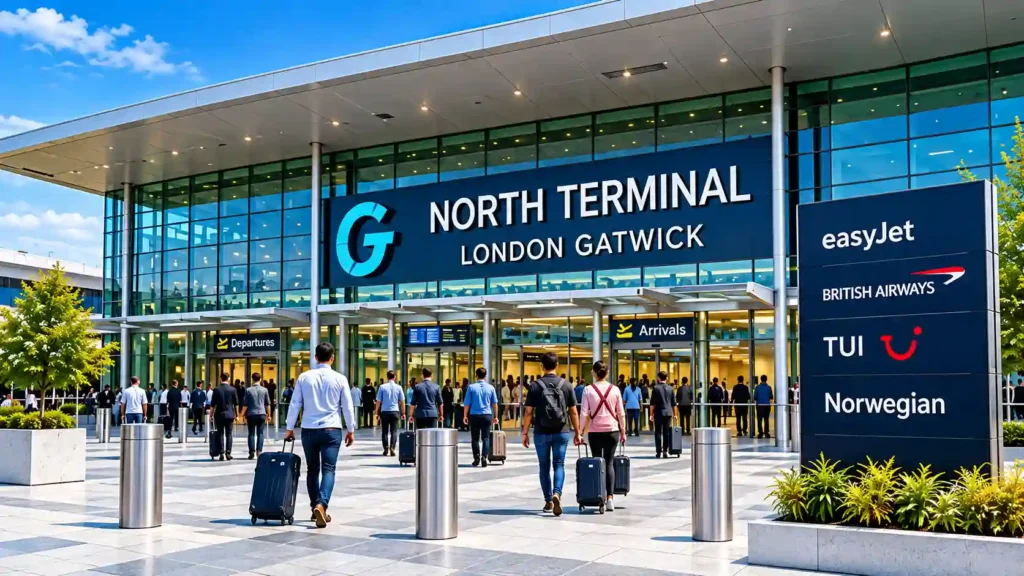
Gatwick South Terminal and railway station link.
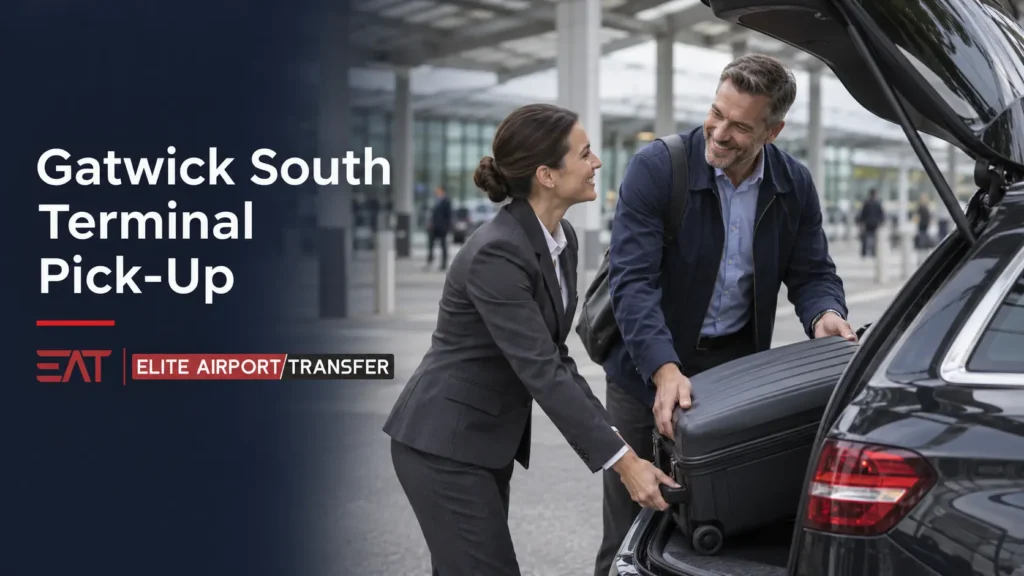
Arriving by car? A pre-booked Gatwick South Terminal taxi means your driver already knows where to be.
Gatwick North Terminal: modern and often overlooked
The North Terminal opened in 1988 and handles a large share of the airport’s leisure flights. It has self-service and traditional check-in, clearly signed security, restaurants and shops, bus and coach links, and the Sofitel London Gatwick via a walkway. There’s no railway station here: train passengers arrive at the South Terminal and take the shuttle across.
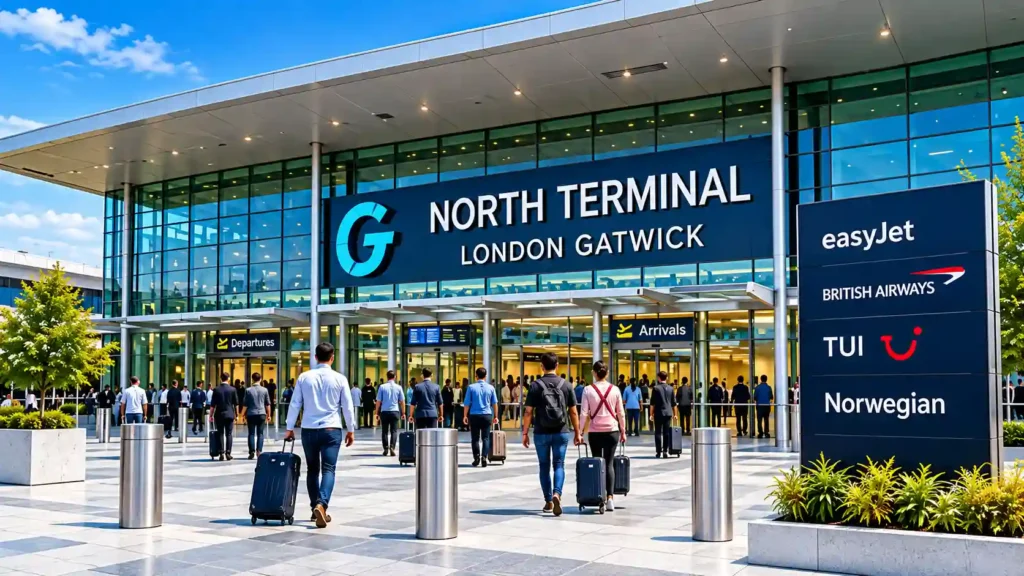
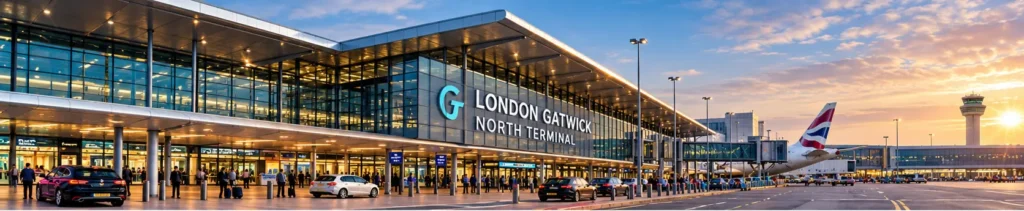
Gatwick North Terminal departures.
Prefer door-to-door? Our Gatwick North Terminal taxi comes with a fixed fare and a driver briefed on your terminal.
North vs South at a glance
| North Terminal | South Terminal | |
| Sat-nav postcode | RH6 0PJ | RH6 0NP |
| Railway station | Use the shuttle from the station | Attached to the terminal |
| On-site hotel | Sofitel | Hilton |
| Which to use | Whichever your airline says. Allocations change, so check your booking and Gatwick’s live flight information. |
The free inter-terminal shuttle
An automated, elevated shuttle links the terminals. Gatwick says it runs every few minutes, 24 hours a day, 365 days a year, and the ride takes around two minutes. From the South Terminal, follow signs for the North Terminal (the station is on the first floor, close to the railway station). From the North, follow signs for the South.
You can’t realistically walk between terminals, so allow time for the walk to the station and the wait, especially with luggage. Connecting flights? Gatwick advises at least 60 minutes in the same terminal and at least 90 minutes between terminals.
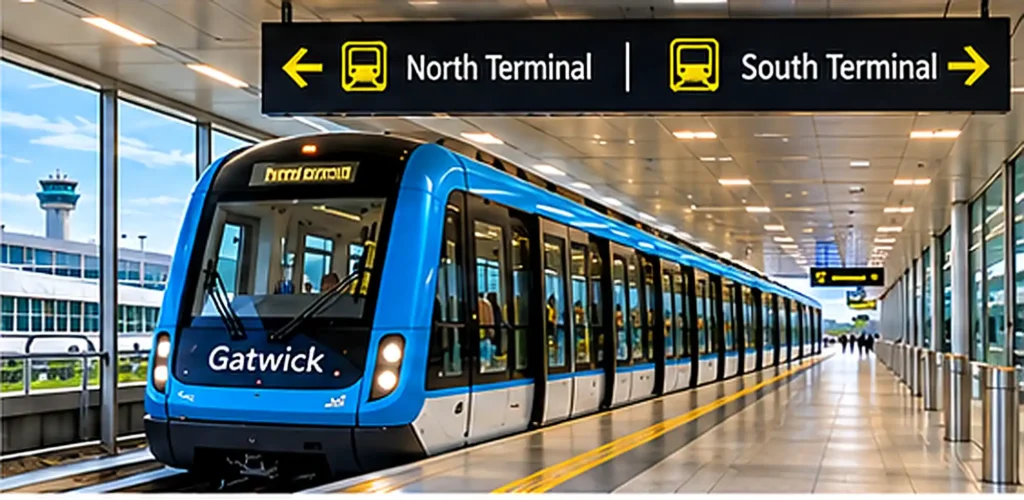
The free shuttle between the terminals.
How to get to Gatwick: every option compared
| Option | Good for | Watch out for |
| Train | Light luggage, central London (Gatwick Express to Victoria takes about 30 minutes) | Peak crowding, strikes and engineering works |
| Coach | Lowest cost | Slower, motorway traffic |
| Drive and drop-off | Flexibility | £10 forecourt charge, then £1 per extra minute |
| Pre-booked taxi | Families, groups, early starts, late arrivals | Book ahead so the vehicle matches your luggage |
The Gatwick drop-off charge in 2026
From 6 January 2026 the forecourt charge at both terminals rose to £10 for up to 10 minutes, then £1 for each extra minute, with a 30-minute maximum stay. It’s paid online and enforced by cameras, so you can’t pay at the terminal. Blue Badge holders are exempt if they register in advance. Gatwick also offers free drop-off at its long-stay car parks with a shuttle bus, but check the official site for current time limits. Whichever option you compare, ask what the quote includes.
Map features worth finding before you arrive
Locate these on the map before you travel: toilets and baby-changing rooms, lifts and ramps, assistance points, quiet areas and lounges, cash machines, left luggage and first aid. If you need special assistance, request it through your airline or travel provider in advance, ideally at least 48 hours before you fly, and mention any mobility needs when booking your transfer. At Elite Airport Transfer, free baby seats can be requested at booking, subject to availability.
How early should you arrive?
Aim for about two hours before short-haul departures and about three before long-haul. Add time for school holidays, bank holiday weekends and early mornings. Arriving by train? Remember the platform walk, and the shuttle if you’re flying from the North Terminal. For many short-haul trips with online check-in and hand luggage only, two hours is enough. With hold luggage in peak season, allow longer.
Meeting someone at arrivals?
Confirm the terminal and flight number, track the flight (times move), and remember passengers still have to clear immigration and collect bags. Forecourt stops are short and chargeable, so don’t leave it until the last minute. With meet and greet, your driver follows the arrangements in your booking confirmation, and flight monitoring means the pickup follows your actual landing time.
Popular journeys from Gatwick
| Route | Typical time | From |
| Gatwick to Central London | 60–75 min | £138 |
| Gatwick to Brighton | 35–45 min | £112 |
| Gatwick to Croydon | 25–35 min | £101 |
| Gatwick to Crawley & Horley | 10–15 min | Get a quote |
| Gatwick to Guildford | 35–45 min | £110 |
| Gatwick to Southampton Cruise Port | 75–100 min | £191 |
Prices and times are indicative. Your booking form shows the exact fixed fare. Changing airports? See Gatwick to Luton and Luton to Gatwick.
Popular transfer routes from Gatwick.
Fixed fare, flight monitoring, free cancellation and 24/7 support, for both terminals.
Why pre-booking beats the queue
A pre-booked transfer doesn’t make Gatwick smaller, but it removes the unknowns after landing: a fixed fare confirmed up front (no meter, no surge), flight monitoring, meet and greet where selected, free cancellation, and vehicles from saloons (4 passengers, 2 large cases) and MPVs (5 passengers, 3 large cases) to 8 and 16-seater minibuses.
Eight habits of confident Gatwick travellers
- Confirm your terminal the night before, and again on the morning.
- Screenshot the map and your booking.
- Use the right postcode: RH6 0PJ (North), RH6 0NP (South).
- Note your check-in zone, security entrance and nearest toilets.
- Check in online.
- Keep your driver’s contact details handy.
- Trust the signs over your memory.
- Ask staff early if you’re unsure.
Understanding the Gatwick Airport map: landside, airside and terminal levels
An airport map is easier to use when you distinguish between landside areas, which you can access before security, and airside areas, which you enter after security. Check-in, bag drop, arrivals meeting points, rail connections and public transport are generally landside; departure gates, most lounges and duty-free shopping are airside.
For departures, follow the signs for your airline’s check-in or bag-drop area first, then security and finally your gate. Gate numbers may be assigned or changed close to departure, so use the airport screens and your airline app rather than relying on a static map.
For arrivals, follow the signs for passport control where applicable, baggage reclaim, customs and the public arrivals hall. The driver meeting point, forecourt and car parks are not interchangeable; check the collection instructions in your booking confirmation.
Gatwick North Terminal map: departures, arrivals and getting around
At North Terminal, start by locating the main terminal entrance, departures check-in area and security route. Travellers with checked bags should look for their airline’s bag-drop desks and confirm the closing time before travelling. Passengers with hand luggage only may be able to proceed towards security after completing online check-in, subject to their airline’s requirements.
After security, consult the live departures screens for your gate and walking time. Food outlets, shops, seating and toilets are distributed around the passenger areas, but individual facilities and opening hours can change. For arrivals, follow the signed route into the public arrivals hall and use your driver’s agreed pickup instructions.
If you arrive at Gatwick by train for a North Terminal flight, the train does not stop at North Terminal. Leave the railway station at South Terminal and follow the signs to the free inter-terminal shuttle.
Gatwick South Terminal map: departures, arrivals and railway connection
South Terminal combines air travel with the airport’s main rail connection. From Gatwick Airport railway station, follow the terminal signs to the South Terminal departures area. If your flight departs from North Terminal instead, follow the inter-terminal shuttle signs rather than looking for a second railway station.
Before security, identify the check-in zone and bag-drop counter listed by your airline. Once through security, allow time to reach the departure gate, especially if travelling with children or passengers who need assistance.
Arriving at South Terminal? Follow the signed arrivals route, collect any hold luggage and check your onward transport. Rail travellers should use the station signs; taxi passengers should follow their booking instructions rather than assume the driver will be waiting on the drop-off forecourt.
Which airlines use Gatwick North and South Terminals?
Airline terminal allocations are an important part of planning your journey, but they are not permanent. Some airlines operate from different terminals, and assignments can change. The most reliable source for your particular flight is the terminal shown on your booking, your airline’s check-in information and Gatwick’s current departures or arrivals listing.
Check the flight number, destination, date and terminal together. If you have booked a taxi, pass the terminal and flight number to the operator and recheck the information on the day. This matters especially when a traveller is being collected by someone who is not on the flight.
Step-by-step: transferring between Gatwick terminals
First, follow the signs marked for the other terminal or inter-terminal shuttle. At South Terminal the shuttle station is close to the railway station; at North Terminal follow the clearly marked signs from the public terminal areas. The shuttle itself is free and takes approximately two minutes once you are on board.
The total transfer takes longer than the ride because you must walk to the shuttle station, wait for the next service and then walk to your destination. Allow extra time for luggage, lifts, busy periods and assistance requirements.
If you are changing flights on separate tickets, you may need to collect checked luggage, pass through immigration where required, travel between terminals, check in again and clear security. A short shuttle ride does not mean a short flight connection; follow the requirements of both airlines and allow a substantial buffer.
Gatwick arrivals map: where to meet your driver or family
Before arranging a pickup, confirm whether the passenger lands at North or South Terminal. An aircraft’s landing time is not the same as the time a passenger emerges into the arrivals hall. Passport control, baggage delivery and walking times can all affect collection.
Agree a specific meeting location in advance: the arrivals hall, a designated pickup area or a named car park, as appropriate to the booking. Do not assume that a driver can wait indefinitely on a charged forecourt. If using meet and greet, check whether the driver will enter the terminal and how they will identify the passenger.
If a flight is delayed, share the flight number and use the flight-status information to coordinate the pickup. Travellers can read more about airport meet and greet and flight monitoring before booking.
Gatwick parking map: short stay, long stay and drop-off
Gatwick has different parking arrangements for short visits, longer stays and passenger drop-off. Short-stay parking is generally more appropriate when you need time to enter the terminal, help someone with luggage or meet an arriving passenger. Long-stay car parks normally involve a transfer to the terminal by shuttle bus.
The terminal forecourts are designed for short drop-offs rather than waiting for arriving passengers. The charge quoted in this guide is the October 2026 information from the supplied article; always confirm the current tariff, exemptions, maximum stay and payment deadline on Gatwick’s official parking and drop-off pages.
When choosing parking, consider your terminal, whether you need accessible spaces, the number of bags, and how much time you have. Keep the booking reference and car park name handy, as “Gatwick parking” does not identify a single location.
Gatwick Airport facilities: toilets, baby changing, lounges and accessibility
Both terminals provide the essentials travellers expect, including toilets, places to eat, shops, passenger information and routes to assistance services. Exact locations vary by terminal and by whether you are before or after security. Use the official interactive airport map for the nearest available facility.
Families should check baby-changing facilities, accessible toilets, lifts, seating and food options before travelling. If you are travelling with a baby or young child, arrange any required car seat with your transfer provider in advance; Elite Airport Transfer explains its baby car seat options on its website.
Passengers requiring assisted travel should contact their airline or travel provider ahead of the journey, preferably at least 48 hours before departure. Assistance arrangements, security procedures and the location of meeting points should be confirmed directly with the airport or airline. Travellers with reduced mobility should not rely solely on the shortest-looking route on a map.
Getting from Gatwick to London, Brighton and nearby towns
The best onward transport depends on where you are going, how many people are travelling, your luggage and your arrival time. Rail is often convenient for London and Brighton; coach services can be economical, while a pre-booked private transfer offers a direct journey to a specific address.
Gatwick Airport railway station is at South Terminal. North Terminal passengers should factor in the shuttle. Before travelling, check the train operator’s latest timetable and any planned engineering works; a quoted journey time does not include waiting or changing services.
Road journeys vary with traffic on the M23, M25 and routes into London. Compare the complete cost for your group, including luggage, child seats and any pickup or waiting charges. For a terminal-specific private journey, see North Terminal taxis and South Terminal taxis.
Common Gatwick map mistakes and how to avoid them
The most common mistake is assuming the airport railway station serves both terminals directly. It is attached to South Terminal; passengers heading to North Terminal need the shuttle. Another is assuming that “arrivals” and “pickup” refer to the same place, when the agreed meeting point may be elsewhere.
Other avoidable problems include using the wrong terminal postcode, following an outdated airline-terminal list, confusing short-stay parking with the drop-off forecourt and allowing only the shuttle’s two-minute ride time for the whole terminal transfer.
Before leaving, check four details together: flight number, terminal, travel mode and the exact meeting or drop-off location. Save the relevant map and booking details offline in case your mobile connection is unreliable.
For current facilities, maps and live flight information, consult the official London Gatwick Airport website and your airline. This guide is a practical overview, not a live terminal map.
Final thoughts
The Gatwick airport map is simple once you break it down: two terminals, one free shuttle, one railway station and a few landmarks worth knowing. The stress comes from the unknowns, like the wrong terminal or an unexpected drop-off charge. Sort those before you leave home, and the road part is easy to hand over.
Choose your terminal, add your flight number and leave the rest to us.
Frequently asked questions
What is the postcode for Gatwick South Terminal?
RH6 0NP is the postcode given for South Terminal in this guide; follow the specific parking or collection instructions for your booking.
What is the postcode for Gatwick North Terminal?
RH6 0PJ is the postcode given for North Terminal in this guide; check your exact car park or pickup destination separately.
Where can I find Gatwick toilets and baby-changing facilities?
Use Gatwick Airport’s current interactive terminal map to locate facilities nearest your check-in area, gate or arrivals route.
Can I change terminals without leaving the airport?
You can use the free inter-terminal shuttle, but passengers changing flights may need to complete arrivals, check-in and security formalities depending on their itinerary.
Where should I meet a taxi at Gatwick Airport?
Follow the pickup location shown in your taxi booking confirmation. Arrivals halls, pickup points and drop-off forecourts are different areas.
Is the Gatwick inter-terminal shuttle free?
Yes. The automated shuttle between North and South Terminals is free.
Is Gatwick North Terminal connected to the railway station?
Not directly. Gatwick Airport railway station is at South Terminal; use the free shuttle to reach North Terminal.
How many terminals does Gatwick have?
Two: the North Terminal and the South Terminal, linked by a free automated shuttle.
Can you walk between the Gatwick terminals?
Not practically. They’re about 1.2 km apart, so use the free shuttle (around two minutes).
Which terminal is the train station in?
The South Terminal. North Terminal passengers take the shuttle after arriving at the station.
How much is the Gatwick drop-off charge?
£10 for up to 10 minutes since 6 January 2026, then £1 per extra minute, with a 30-minute maximum. Check Gatwick’s website for the latest charges.
Is two hours enough at Gatwick?
For many short-haul flights with online check-in and hand luggage only, yes. For long-haul flights or peak days, allow longer.
How long is Gatwick to central London?
Around 60–75 minutes by road, depending on traffic, or about 30 minutes by Gatwick Express to Victoria.
Do you cover both terminals?
Yes, North and South, 24 hours a day. You can also request a free baby seat, subject to availability.